
Equipment care
How Often Should You Have Your Wheelchair Professionally Cleaned?
Six months, three months or monthly? It depends on use, exposure, environment and everyday care. This guide walks through each.
One of the most common questions about wheelchair care is: how often should my wheelchair have a detailed professional clean?
There is not one schedule that is right for everyone. A wheelchair used occasionally at home has very different needs from a powered chair used for many hours a day, indoors and out.
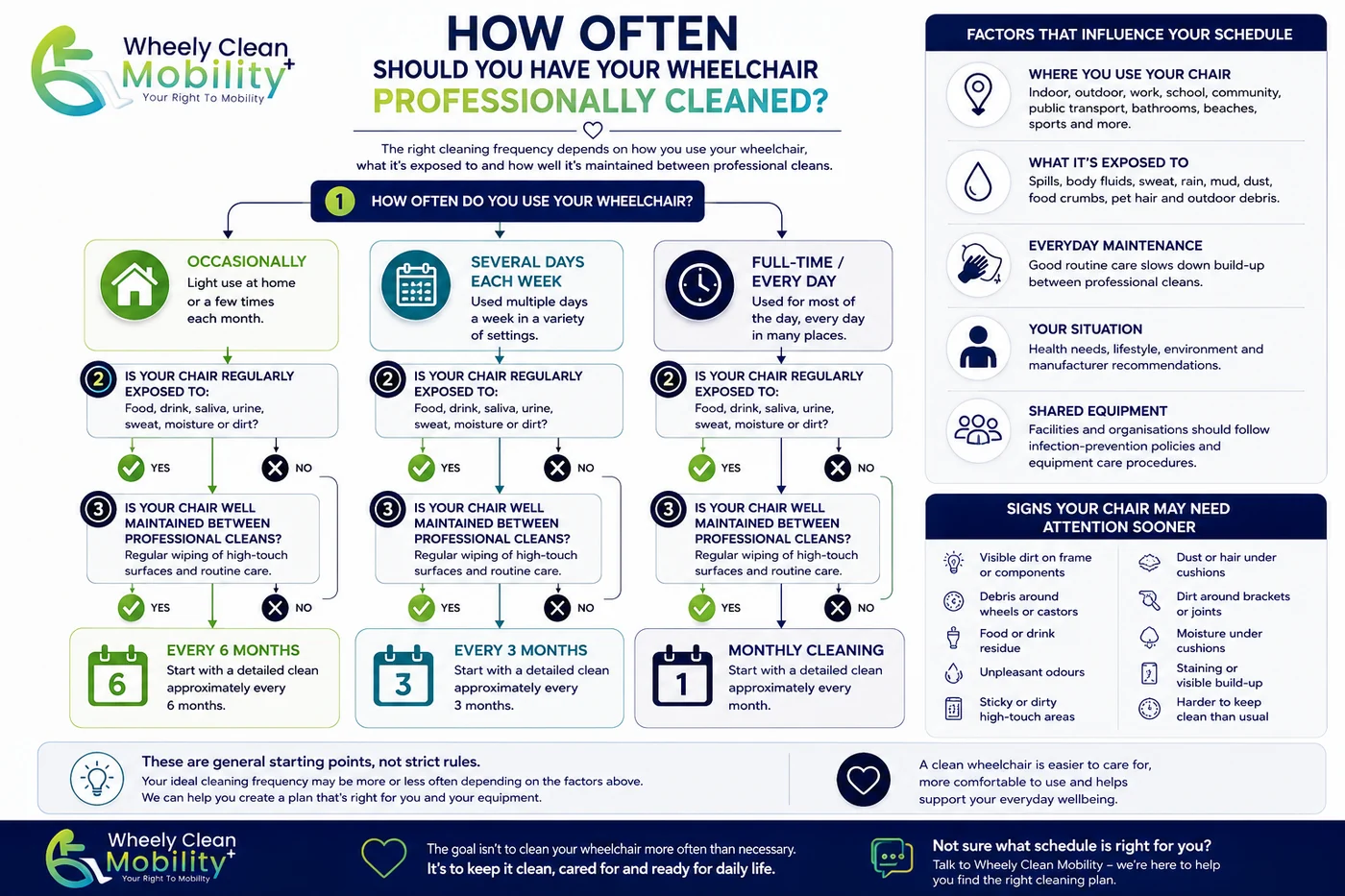
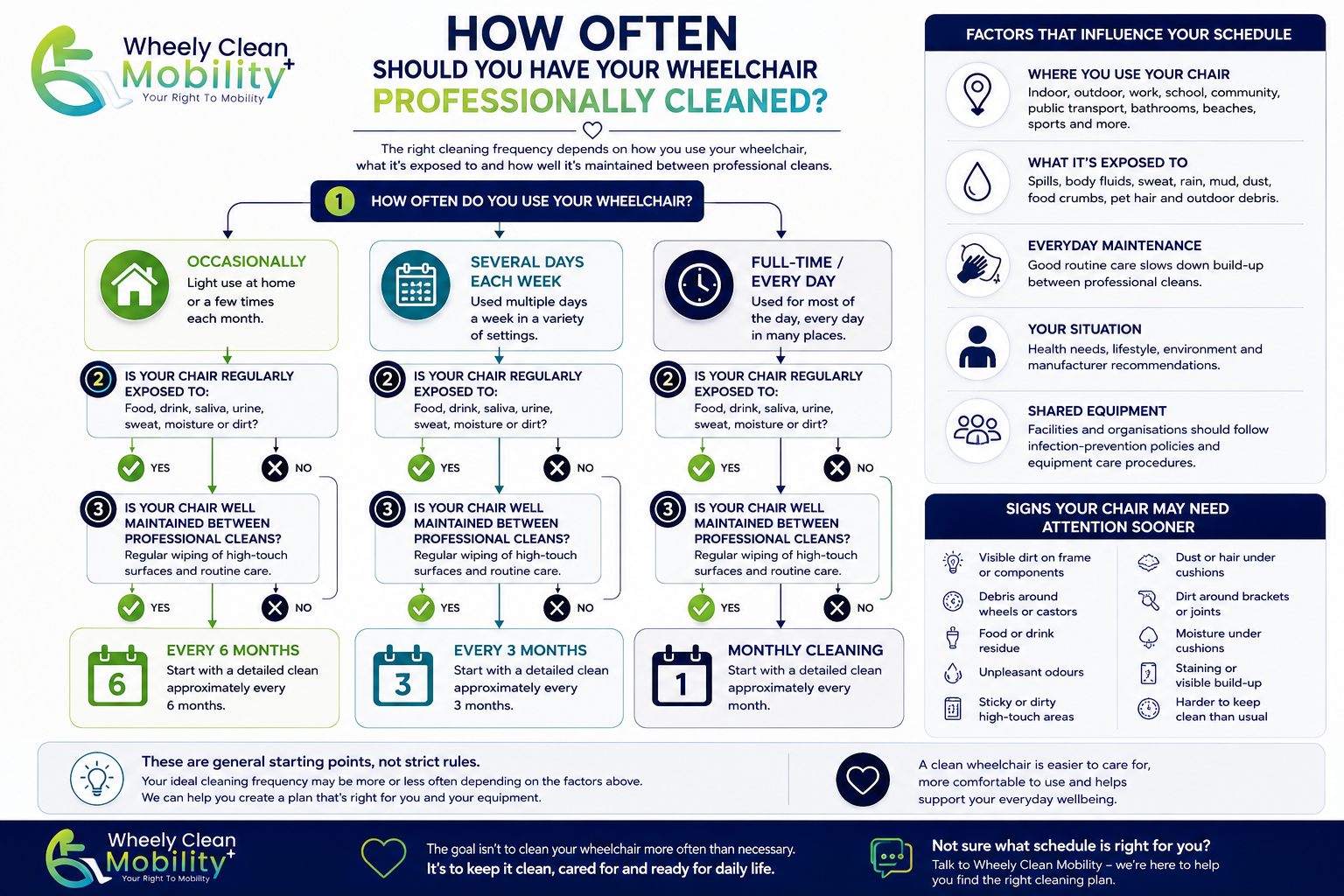
The right frequency depends on how you use your wheelchair, what it is exposed to, and how well it is maintained between professional cleans.
Start with how often you use your wheelchair
Occasional use
If you use your wheelchair occasionally and it is routinely kept clean and dry, you may need detailed cleaning less often. As a general starting point, consider a detailed clean approximately every six months.
More frequent cleaning may be appropriate if the chair is exposed to spills, moisture or significant dirt.
Regular use
If you use your wheelchair several days each week, there is naturally more opportunity for dust, hair, food particles, moisture and everyday debris to accumulate. A detailed clean approximately every three months is a useful starting point, depending on how the chair is used and maintained.
Full-time use
A wheelchair used throughout the day becomes part of almost every environment its user enters — home, vehicles, workplaces, shops, appointments, bathrooms, footpaths and community spaces.
At that level of use, both high-touch and hard-to-reach components need more attention. For some full-time users a monthly detailed clean is appropriate, particularly where the equipment sees heavier exposure or is difficult to maintain thoroughly in between.
These intervals are guides, not rules.
What is your wheelchair exposed to?
Frequency of use is not the only consideration. Think about what comes into contact with your wheelchair during an ordinary week:
- food and drink
- sweat and body oils
- saliva
- urine or other bodily fluids
- rain and moisture
- mud or soil
- pet hair
- dust, sand and food crumbs
- outdoor debris
If spills or bodily fluids contact the wheelchair, deal with them promptly using a method appropriate for the equipment, rather than waiting for the next scheduled clean. Frequent exposure may also mean the chair benefits from more regular detailed cleaning.
Where do you use your wheelchair?
Two people who use their chairs for the same number of hours can still have very different cleaning needs. Someone mainly indoors has different requirements from someone regularly travelling outdoors.
Consider whether your chair frequently travels through outdoor pathways, gardens, workplaces, schools, healthcare environments, public transport, shopping centres, bathrooms, sporting environments, or beaches and sandy areas.
Wheels and castors in particular encounter a wide variety of surfaces through the day. Your environment matters as much as the hours you spend in the chair.
How well is the chair maintained in between?
Good everyday care makes a significant difference to how quickly dirt and debris accumulate. Frequently touched areas can be maintained according to the manufacturer's instructions — armrests, push handles, hand rims, controls, brakes, footplates and seating surfaces.
Regularly checking underneath cushions and around accessible components also helps you spot moisture, dirt or debris before significant build-up occurs.
Professional detailed cleaning should complement good routine care, not replace it. Our guide on caring for equipment between cleans covers the everyday side.
Signs your wheelchair may need attention sooner
Rather than relying entirely on the calendar, pay attention to the condition of the equipment. It may be worth arranging a clean sooner if you notice:
- visible dirt accumulating around the frame
- debris around wheels or castors
- food or drink residue
- unpleasant odours
- sticky or dirty high-touch surfaces
- significant dust or hair underneath the seating area
- dirt collecting around brackets and joints
- moisture underneath cushions
- staining or visible build-up
- the chair becoming harder to keep clean through normal routine care
A cleaning plan should stay flexible enough to respond to how the wheelchair is actually being used.
A simple starting guide
If you are unsure where to begin:
- Occasional use → approximately every six months
- Several days each week → approximately every three months
- Full-time or intensive daily use → consider monthly
Then adjust for exposure, environment, everyday cleaning, individual circumstances and manufacturer guidance. Some chairs need professional attention more often. Others, used lightly and carefully maintained, need it less.
Shared wheelchairs are different
Wheelchairs used by several people should not necessarily follow the same schedule as a personal chair.
Hospitals, aged-care facilities, rehabilitation providers, disability organisations and other services have their own infection-prevention and equipment-cleaning procedures. Shared equipment should be cleaned and disinfected according to those policies, applicable infection-control requirements and the manufacturer's instructions.
Periodic professional detailed cleaning can then form an additional part of the organisation's equipment-care programme.
Finding the right schedule for your wheelchair
The most useful question is not “has it been three months yet?” It is “based on how my wheelchair is used and maintained, does it need a detailed clean?”
We can help wheelchair users, families, carers and organisations work out a practical schedule based on the equipment and how it is actually used.
The goal is not to clean your wheelchair more often than necessary. It is to settle on a sensible routine that keeps an important piece of everyday equipment clean, cared for and ready for daily life.
Please note. The intervals above are general starting points, not clinical or infection-control advice. Always follow the cleaning instructions supplied with your wheelchair, and any procedures that apply where the equipment is used.
Need a clean booked? Wheely Clean Mobility cleans wheelchairs and mobility equipment across the Perth metropolitan area, in your own home. See our services or book a time.