
Hygiene & research
What Are Biofilms?
Microorganisms do not always sit loose on a surface. Understanding biofilms explains why looking clean and being thoroughly clean are not the same thing.
When we think about a dirty wheelchair, we usually picture something we can see — dust on the frame, marks on the armrests, crumbs underneath a cushion, dirt around the wheels.
But microorganisms do not always exist as loose individual cells sitting on a surface. Under the right conditions they can attach to surfaces and develop into organised communities known as biofilms.
Understanding biofilms helps explain why good equipment hygiene involves more than making a surface look clean.
What exactly is a biofilm?
A biofilm is a structured community of microorganisms that attaches to a surface and becomes surrounded by a protective matrix the microorganisms produce themselves.
An everyday example is dental plaque. Rather than microorganisms sitting independently on a surface, a biofilm lets them exist together inside this protective structure.
Biofilms can develop on many types of surface, and are particularly well studied in healthcare, water systems and medical-device environments.
How does a biofilm develop?
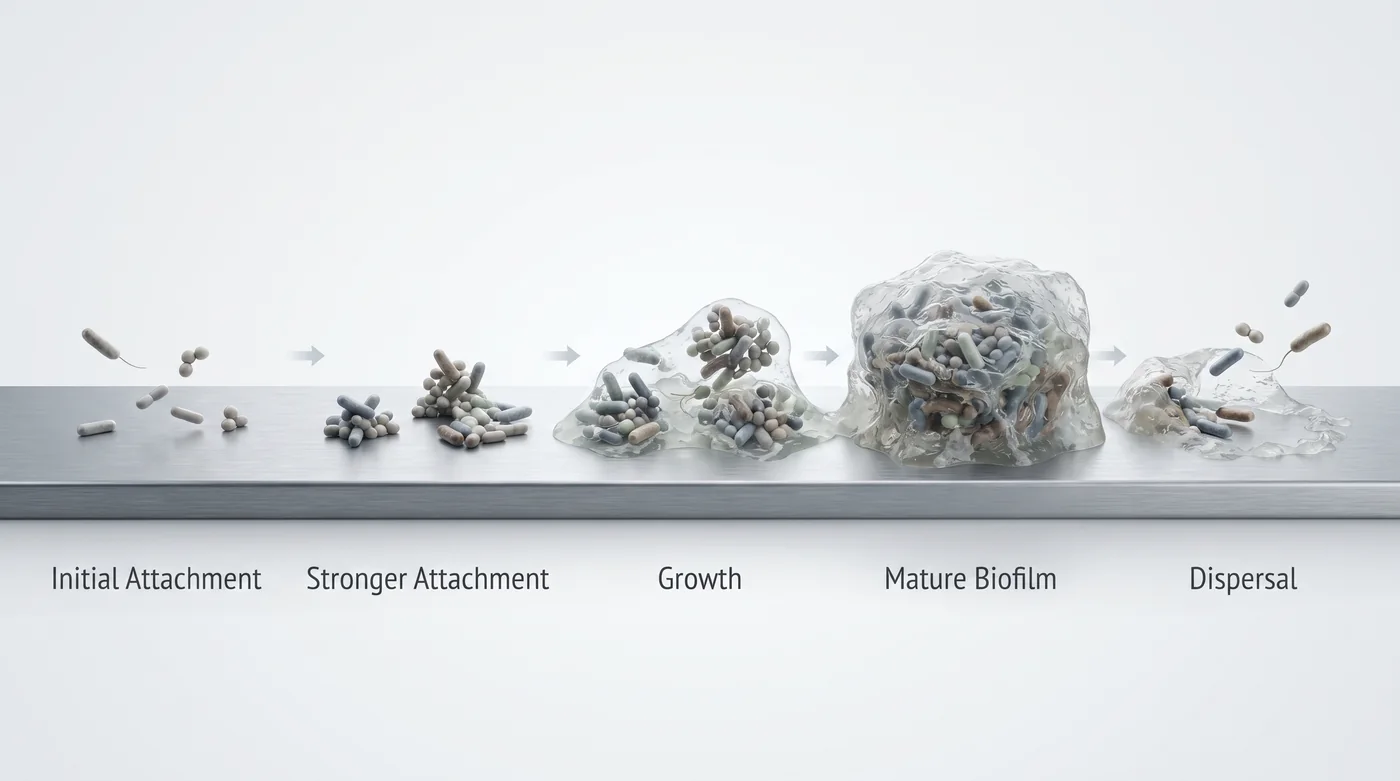
Biofilm development is a process rather than something that appears instantly. In simplified terms it involves several stages.
1. Initial attachment
Microorganisms come into contact with a suitable surface and begin attaching to it.
2. Stronger attachment
Some remain attached and establish themselves more securely on the surface.
3. Growth
The microorganisms reproduce and begin producing a protective extracellular matrix around the developing community.
4. Mature biofilm
The biofilm becomes a more organised microbial community, with organisms held inside its protective structure.
5. Dispersal
Some microorganisms eventually leave the biofilm and can establish themselves elsewhere.
This ability to attach, grow and persist is one reason biofilms receive so much attention in infection-control and environmental-hygiene research.
Why are researchers interested in biofilms?
Biofilms matter because microorganisms living within them can behave differently from those existing freely on a surface. The surrounding matrix provides protection and makes the community more resilient.
Research into biofilms on medical devices has shown they can act as reservoirs for microorganisms and can show increased resistance to antimicrobial treatments and sanitising processes. This is a particular challenge with implanted medical devices, where biofilm-related infections can be clinically significant.
An important distinction. Implanted medical devices are not the same as external mobility equipment. Research about infections associated with catheters, implants or prosthetic devices should not be read as evidence that an external wheelchair carries the same clinical risk.
What does this have to do with wheelchair cleaning?
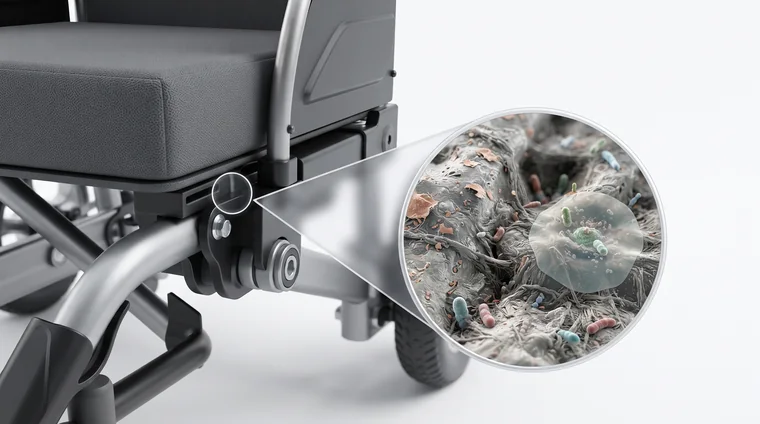
Wheelchairs are complex pieces of equipment with many different surfaces — plastic, metal, rubber, upholstery, foam, textured surfaces, seams, joints, brackets, wheels and castors.
A wheelchair also encounters moisture, food residue, sweat, dust, dirt and other organic material during normal everyday use. Those characteristics make thorough equipment hygiene worth considering, particularly in areas not easily reached during routine cleaning.
The practical lesson from biofilm research is not that every wheelchair is covered in dangerous biofilm. It is that microbial contamination can be more complicated than what we can see with our eyes.
Looking clean and being thoroughly clean are not the same thing
A quick wipe is genuinely useful for everyday wheelchair care. Frequently touched surfaces such as armrests, handles, hand rims and controls deserve regular attention according to the manufacturer's instructions.
But a wheelchair contains far more than its obvious upper surfaces. Consider the areas under cushions, around brackets, inside joints, around castors, underneath armrests, around footplates and between connected components.
Dust, hair, moisture and other material accumulate in these places even when the wheelchair looks relatively clean from a distance. That is why routine cleaning and periodic detailed cleaning serve different purposes. There is more in our guide to the areas most often overlooked.
Moisture deserves particular attention
Moisture can create conditions that favour microbial growth on suitable surfaces. It is worth paying attention to areas that may stay damp after spills, rain, cleaning, sweating, bathroom use or wet outdoor environments.
Cushions and covers should be maintained according to their manufacturer's instructions, and components allowed to dry properly before going back into use. Powered wheelchairs need additional care, because water and cleaning liquids may damage electronic components.
Does disinfectant automatically remove a biofilm?
Not necessarily. Cleaning and disinfection are related but not identical. Cleaning generally means removing dirt, organic material and contamination from a surface. Disinfection uses an appropriate process or product to reduce or inactivate microorganisms.
Biofilms complicate this, because their protective structure can make embedded microorganisms harder to address than organisms sitting freely on a surface. This is one reason physical cleaning and proper surface preparation matter within an overall hygiene process.
Never use harsh chemicals, excessive moisture, steam or other cleaning methods on a wheelchair unless they are appropriate for that particular equipment and consistent with the manufacturer's guidance. The correct method depends entirely on the equipment and materials involved.
Why detailed wheelchair cleaning matters
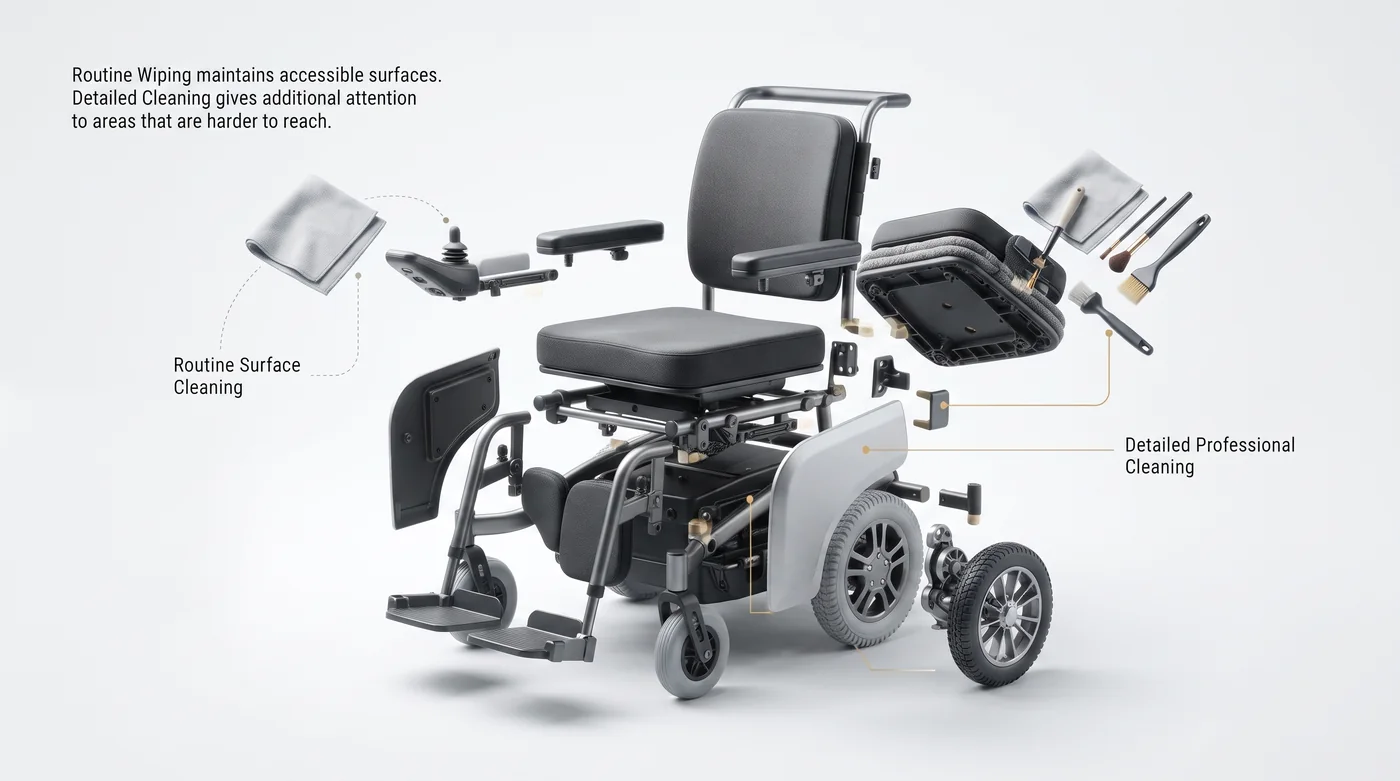
Wheelchairs contain numerous areas that are difficult to reach during normal everyday cleaning. Detailed cleaning is an opportunity to work systematically through the accessible parts of the equipment, rather than concentrating only on the surfaces that are easiest to see.
Depending on the wheelchair and the manufacturer's requirements, that can include wheels and castors, frames, armrests, footplates, hand rims, push handles, seating components, accessible brackets and joints, and frequently touched controls.
The goal is straightforward: a more complete approach to caring for equipment that plays an important role in everyday life.
Better hygiene starts with understanding what we cannot see
Biofilm research reminds us that cleanliness is not purely visual. A surface can look clean while microorganisms and microscopic material remain invisible.
That does not mean wheelchair users should worry about every surface they touch. It reinforces the value of sensible routine cleaning, appropriate equipment care, and periodic detailed attention to the areas commonly overlooked.
How Wheely Clean Mobility can help
We believe wheelchair hygiene should be thorough, practical and respectful of the equipment and the person who relies on it. Our cleaning services are designed to complement regular everyday care, with particular attention to areas that are difficult to reach during routine cleaning.
Because some of the most important areas to clean are not the easiest ones to see.
Please note. This article is general education about biofilm science, not clinical or infection-control advice, and it does not claim that cleaning a wheelchair prevents infection. Always follow the cleaning instructions supplied with your equipment, and speak with your treating team about anything specific to your health.
Need a clean booked? Wheely Clean Mobility cleans wheelchairs and mobility equipment across the Perth metropolitan area, in your own home. See our services or book a time.