
Equipment care
Wheelchair Cleaning Hotspots: Areas You Shouldn’t Overlook
Some parts of a wheelchair are obvious when cleaning. Others are touched constantly, or hidden away, and get missed. Here is where to look.
A wheelchair is used throughout the day and comes into regular contact with hands, clothing, floors and different environments. Some areas are obvious when cleaning. Other frequently touched or difficult-to-reach components are easily overlooked.
Knowing where to focus can help wheelchair users, families and support workers maintain better everyday equipment hygiene.
Manual wheelchair: key areas to check
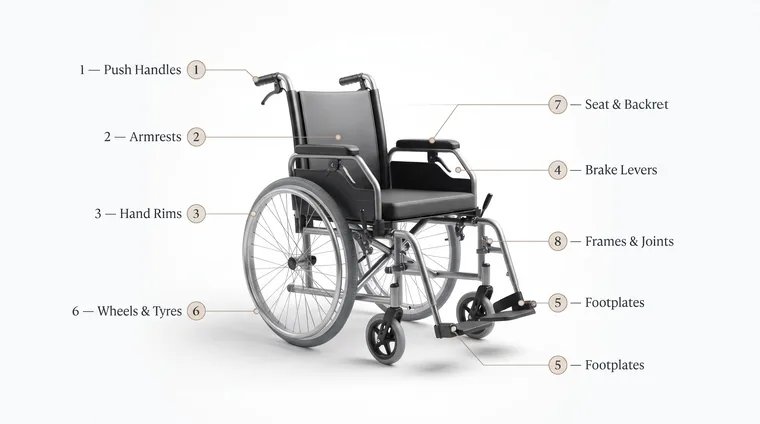
When routinely cleaning a manual wheelchair, pay particular attention to:
1. Push handles
Push handles are regularly touched by family members, carers and support workers, and should be included in routine cleaning.
2. Armrests
Hands and forearms can remain in contact with armrests for extended periods, which makes them an important high-touch surface.
3. Hand rims
For self-propelled wheelchair users, hand rims are touched repeatedly throughout the day, and are also exposed to dirt from the surrounding environment.
4. Brakes and brake levers
These small components receive frequent hand contact but are easily missed during a quick clean.
5. Footplates
Footplates are exposed to footwear, dirt and environmental debris, and deserve regular attention.
6. Wheels, tyres and castors
Wheelchair wheels continuously travel across indoor and outdoor surfaces. Do not limit cleaning to the parts of the wheelchair above floor level.
7. Seat and backrest
Regular contact with clothing, skin, food particles and everyday debris means seating surfaces should be maintained according to the manufacturer's cleaning instructions.
8. Frames, joints and hard-to-reach areas
Dust, hair, fibres and debris accumulate around brackets, hinges, bolts and narrow spaces that a quick surface wipe does not reach.
Shared wheelchairs need additional attention
Wheelchairs used by more than one person require an appropriate cleaning and disinfection process between users, in line with the organisation's infection-control procedures.
For a personal wheelchair, regular routine cleaning helps prevent dirt and debris from gradually accumulating.
How often a wheelchair needs cleaning depends on how frequently it is used, where it is used, exposure to spills or contamination, the user's circumstances and the manufacturer's recommendations.
Power wheelchairs: do not forget the controls
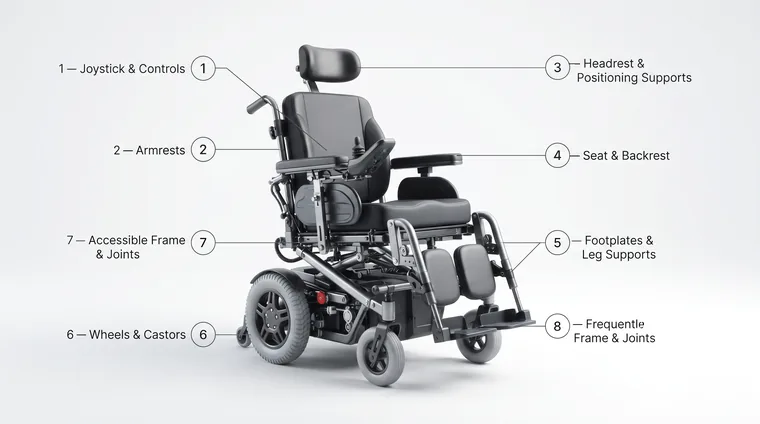
Powered wheelchairs contain many of the same high-contact areas as manual wheelchairs, together with additional electronic controls and positioning components. Pay attention to:
- joystick and control surfaces
- armrests
- headrests and positioning supports
- push handles
- seat and backrest
- footplates and leg supports
- wheels and castors
- accessible frame components
- frequently adjusted controls and accessories
Take care around electronics
Power-wheelchair controls and electrical components need special consideration.
Always follow the wheelchair and control-system manufacturer's cleaning and disinfection instructions. Avoid saturating electronic components with liquid, and do not assume that one cleaning chemical is appropriate for every wheelchair or joystick system.
If in doubt, leave it. A controller or motor housing that has been soaked is a far more serious problem than a controller that has not been cleaned this week. Mention anything you are unsure about at your next professional clean.
Routine cleaning and detailed cleaning
Everyday cleaning is important, but it is not always possible to reach every component of a wheelchair during routine maintenance.
Over time, dust, hair, food residue and other material accumulate underneath seats, around wheel assemblies, behind brackets and inside narrow spaces. That is where periodic detailed cleaning complements everyday care.
Routine care, plus periodic detailed cleaning, gives a more complete approach to wheelchair hygiene than either on its own.
How Wheely Clean Mobility can help
We provide detailed cleaning for wheelchairs and mobility equipment, with particular attention to the areas that are difficult to reach during everyday cleaning — because wheelchair hygiene is not only about what you can see.
Cleaner equipment. Detailed care. Greater confidence.
Please note. This is general guidance. Always follow the cleaning instructions supplied by your wheelchair and control-system manufacturer, and any infection-control procedures that apply where the equipment is used.
Need a clean booked? Wheely Clean Mobility cleans wheelchairs and mobility equipment across the Perth metropolitan area, in your own home. See our services or book a time.