
Hygiene & research
Why Wheelchair Cleaning Matters: What Research Tells Us About Hygiene and Infection Control
Published studies have found healthcare-associated organisms on wheelchairs. Here is what that research says, and what it means for everyday equipment care.
Wheelchairs and other mobility equipment are an important part of everyday independence for thousands of Australians. They travel through homes, hospitals, rehabilitation centres, aged-care facilities, shopping centres, public spaces and supported accommodation.
Because wheelchairs are touched frequently and move continuously between different environments, they can also collect dirt, organic material and microorganisms in places that ordinary day-to-day wiping may miss.
Research into healthcare equipment and environmental hygiene increasingly highlights an important point: a wheelchair that looks clean is not necessarily thoroughly clean.
Understanding where contamination can accumulate — and why regular, detailed cleaning matters — can help wheelchair users, families, carers and organisations maintain better standards of equipment hygiene.
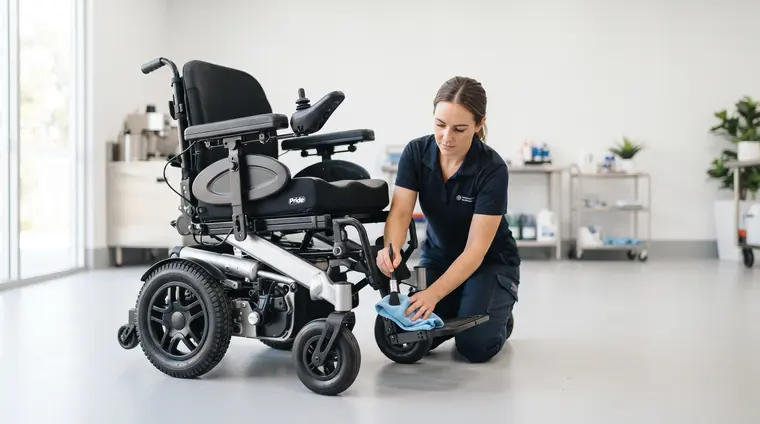
Wheelchairs have many high-touch areas
Think about how many parts of a wheelchair are touched during an ordinary day. Hands regularly contact:
- armrests
- push handles
- hand rims
- brakes
- joysticks and controls
- seat edges
- positioning supports
- footplates and accessories
The wheels and tyres are simultaneously travelling across floors, footpaths, bathrooms, healthcare environments and outdoor surfaces.
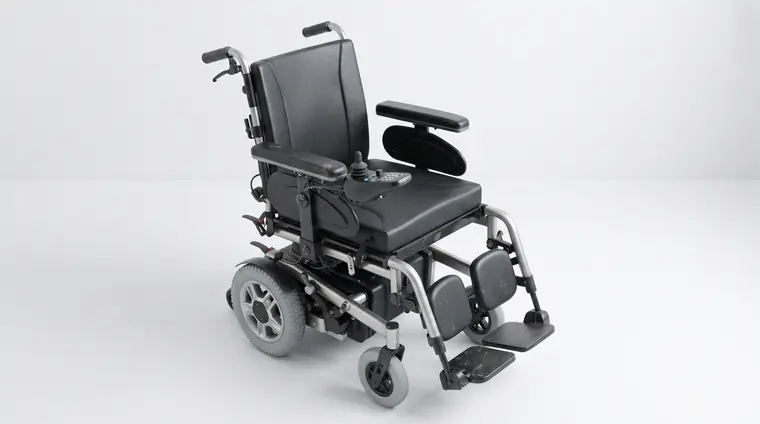
Research has demonstrated that wheelchairs can become contaminated with potentially harmful microorganisms. One hospital study investigating wheelchair contamination identified bacteria including MRSA, Pseudomonas aeruginosa and Acinetobacter baumannii on sampled wheelchairs.
Another study of shared wheelchairs in a hospital and long-term care facility detected healthcare-associated pathogens on both wheelchair wheels and wheelchair bodies, including Clostridioides difficile spores, MRSA and VRE.
These findings do not mean that using a wheelchair is unsafe. They demonstrate why mobility equipment deserves appropriate attention within cleaning and hygiene routines.
A wheelchair can travel through many environments
Unlike most furniture or fixed medical equipment, wheelchairs move.
A wheelchair may travel from a bedroom to a bathroom, vehicle, medical appointment, shopping centre, restaurant or community facility — all within the same day. For shared wheelchairs, this movement can be greater still.
Researchers studying wheelchair movement in a healthcare facility recorded 851 wheelchair transports in just three days, involving movement between inpatient wards, outpatient clinics, radiology and physical therapy.
This mobility is one reason wheels and other frequently contacted components should not be overlooked during cleaning. Cleaning only the seat and armrests addresses part of the wheelchair, not the complete piece of equipment.
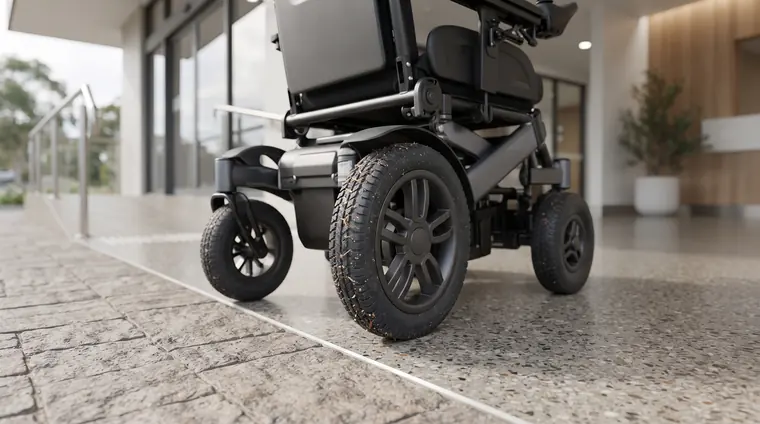
The areas you cannot easily see matter too
Wheelchairs are complex pieces of equipment. Depending on the model, they may contain brackets and hinges, bolts and connection points, seams, textured surfaces, upholstery, removable cushions, wheel hubs and spokes, castors, footrests, positioning equipment, electrical controls, and small gaps between components.
These areas can be considerably harder to reach with a cloth or disinfectant wipe.
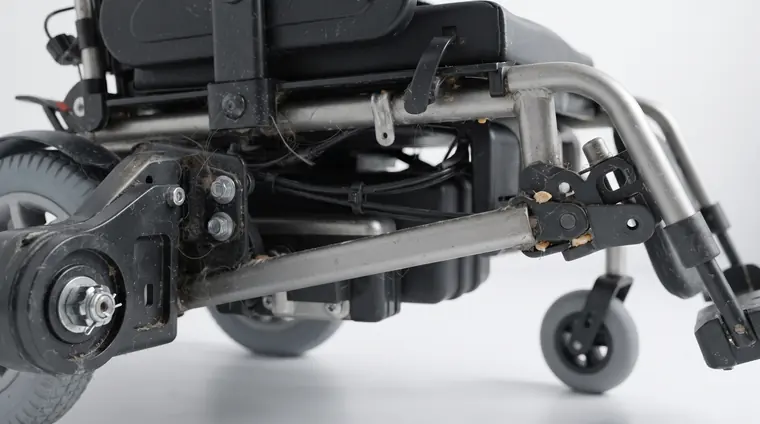
A Canadian study examining wheelchair cleaning practices across healthcare and long-term-care facilities identified several practical problems. Among participating facilities, 52% reported failure to clean and disinfect wheelchairs between patients, while 42% identified wheelchair cushions as difficult to clean.
This highlights an important distinction between routine surface cleaning and a more detailed wheelchair clean. A quick wipe is useful for everyday maintenance, but it may not reach dirt and contamination accumulated underneath, behind or between components.
Why biofilms are important
One reason detailed cleaning matters is the phenomenon known as a biofilm.
A biofilm is a community of microorganisms surrounded by a protective matrix that can attach to a surface. Biofilms matter in healthcare hygiene because organisms living within them can be more difficult to remove or destroy than free-floating microorganisms.
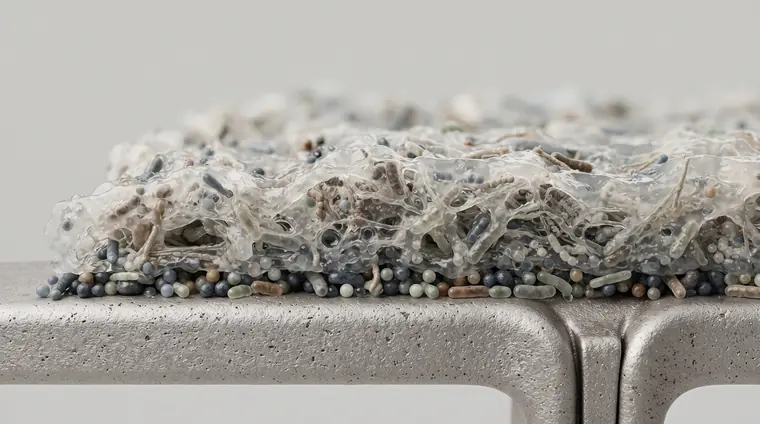
Research has identified dry-surface biofilms containing pathogens in healthcare environments, and has shown that these structures can resist conventional cleaning and disinfection.
This helps explain why applying disinfectant to a visibly accessible surface should not automatically be considered equivalent to thoroughly cleaning the equipment. Effective cleaning requires attention to both the method and the physical removal of accumulated material.
Wheels should not be forgotten
Wheelchair wheels deserve particular attention because they are continuously in contact with the ground. Research into shared wheelchairs has found healthcare-associated pathogens on wheels as well as on the body of the chair.
There is also evidence that the relationship between tyres, hand rims and users' hands can influence bacterial transfer. Researchers studying wheelchair design have specifically investigated contamination transferred to users' hands during propulsion.
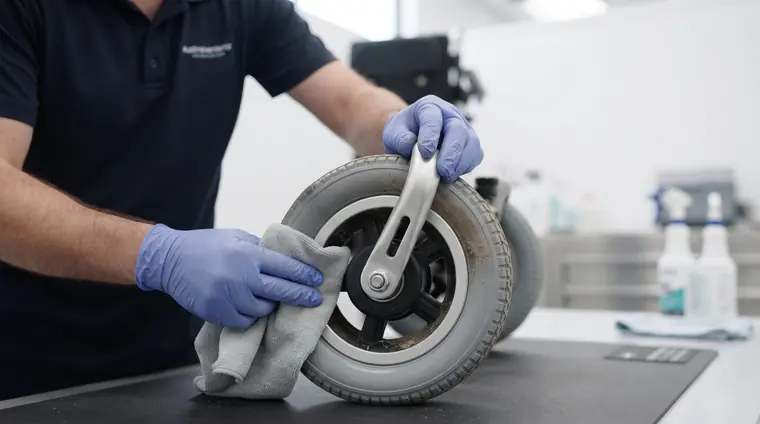
For practical wheelchair hygiene, this means a cleaning process should consider more than the obvious upper surfaces. Castors, tyres, hand rims, wheel components and other areas close to the ground should form part of a comprehensive approach where appropriate for the equipment.
Shared equipment requires particular attention
Wheelchair hygiene becomes especially important when equipment is shared between different people.
A survey of 48 Canadian acute-care hospitals, chronic-care hospitals and long-term-care facilities found significant challenges in wheelchair cleaning. Researchers reported difficulty distinguishing clean from dirty wheelchairs, wheelchairs not always being cleaned between patients, difficulty cleaning cushions and a lack of clear cleaning guidance.
The researchers concluded that wheelchair cleaning and disinfection was not being optimally performed in many of the facilities they examined.
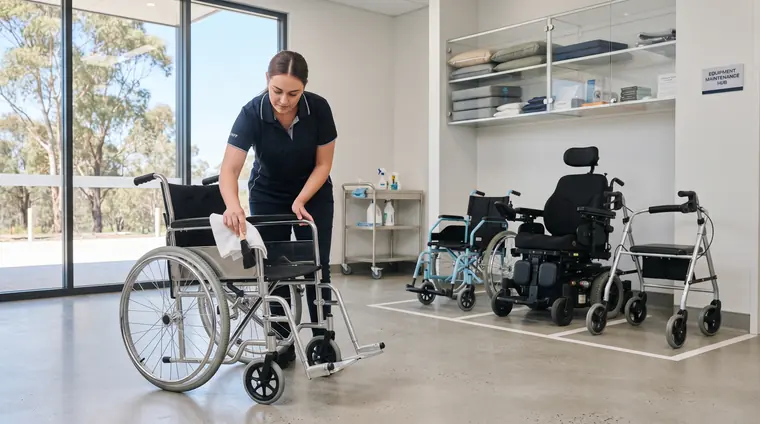
This is particularly relevant for hospitals, aged-care facilities, rehabilitation centres, disability organisations, equipment providers and other environments maintaining fleets of mobility equipment. Having a cleaning process is important — but so are consistency, accountability and knowing which parts of the equipment have actually been cleaned.
Better cleaning can make a measurable difference
The importance of equipment cleaning is not based solely on laboratory findings. Australian research has demonstrated measurable clinical benefits from improving the cleaning and disinfection of shared medical equipment.
The CLEEN trial, conducted across ten wards of a single hospital on the New South Wales Central Coast and involving 5,002 patients, introduced an enhanced cleaning programme that included additional dedicated cleaning time, education and auditing.
Following the intervention, researchers reported a 34.5% relative reduction in healthcare-associated infections.
The CLEEN trial examined shared medical equipment broadly rather than wheelchairs alone. What it supports is a principle: improving the quality and frequency of equipment cleaning can contribute to better infection-control outcomes.
Everyday cleaning and professional deep cleaning serve different purposes
Regular cleaning by wheelchair users, family members or support workers remains important. Frequently touched areas should be maintained according to the manufacturer's instructions, and spills or visible contamination addressed promptly.
However, everyday maintenance and periodic detailed cleaning are not necessarily the same thing. A professional cleaning process can concentrate on areas that are difficult to reach during normal cleaning, and can provide a more systematic approach to the whole chair.
Depending on the wheelchair and the manufacturer's requirements, that may include wheels and castors, hand rims, brakes, armrests, footplates, frames, accessible brackets and joints, upholstery and cushions, push handles, joystick and control areas, and other frequently touched components.
Any cleaning method should always be appropriate for the materials, electronics and care requirements of the particular wheelchair.
Cleaning is also about caring for the equipment
Wheelchair cleaning is not only an infection-control consideration.
Dirt, hair, food residue and dust gradually accumulate around moving components and hard-to-access areas. Regular inspection during cleaning may also make it easier to notice visible wear, loose components or areas needing maintenance.
Cleaning does not replace servicing or repairs, but a clean wheelchair makes it easier to see the condition of the equipment.
Creating a better standard of wheelchair hygiene
Wheelchairs are personal, frequently used pieces of equipment. For many people they are in use for hours every day. Their hygiene deserves more attention than an occasional wipe of the most visible surfaces.
Research tells us that wheelchairs can carry microorganisms, that wheels and high-touch components can become contaminated, and that cleaning complex mobility equipment presents practical challenges.
It also tells us something encouraging: better equipment-cleaning practices can make a difference.
At Wheely Clean Mobility, our focus is on detailed wheelchair and mobility-equipment cleaning that goes beyond the areas people normally reach during everyday cleaning. Our aim is simple: to help wheelchair users, families, carers and organisations maintain cleaner, fresher and better-cared-for equipment.
Research used for this article
This article draws on published research into wheelchair contamination, environmental hygiene, biofilms and the cleaning of shared medical equipment, including work published in the American Journal of Infection Control, World Journal of Microbiology and Biotechnology, Journal of Hospital Infection and The Lancet Infectious Diseases.
The CLEEN trial is: Browne K, White NM, Russo PL, et al. Investigating the effect of enhanced cleaning and disinfection of shared medical equipment on health-care-associated infections in Australia (CLEEN): a stepped-wedge, cluster randomised, controlled trial. The Lancet Infectious Diseases 2024;24(12):1347–56. doi:10.1016/S1473-3099(24)00399-2
Please note. This information is provided for general education. It does not replace clinical infection-control advice, manufacturer cleaning instructions or guidance from a healthcare professional. Cleaning is part of looking after equipment well; nothing here should be read as a promise about preventing infection or illness.
Need a clean booked? Wheely Clean Mobility cleans wheelchairs and mobility equipment across the Perth metropolitan area, in your own home. See our services or book a time.